From their first meeting in Barcelona to their reunion in Madrid, a portrait of a drummer for whom music and friendship are built on the same attentiveness to others.
I met him in Barcelona, while we were presenting the jazz-theatre project The AfterSound. I can no longer place our first encounter precisely in my memory, but I clearly remember the impression he made on me: a calm, attentive man, with no need to turn his musical experience into a calling card delivered aloud. A few months later, in Madrid, I would discover just how faithfully his music resembled him.
Artists often have two biographies. One is public, built from stages, projects, collaborations and applause. The other exists in conversations between concerts, in the way a person listens, in small gestures and in the way they relate to others.
In Frank Durand’s case, the two biographies do not contradict each other.
Frank is a Cuban drummer, percussionist and musician, shaped by a culture in which rhythm is not merely the foundation of music, but one of its essential forms of thought. His playing brings together jazz, funk, Afro-Cuban music and experience acquired in a wide range of artistic settings.
But such a list says very little about what happens when he sits down at the drums.
I met him in Barcelona during the days of The AfterSound, at a time when music found its way into almost every conversation, even when we were not speaking directly about it. Our performance was attempting to bring jazz and theatre into the same construction, without allowing either to become merely the background for the other. In such a context, you meet people who approach music through reputation and others who relate to it through a deeper instinct.
Frank clearly belonged to the second category.
I do not remember exactly where we met or what our first words were. I do, however, remember one of our conversations away from the stage. It had neither the solemnity of a discussion about art nor the air of a confession carefully prepared to become a quotation. It was a natural conversation in which I discovered someone attentive to what he was being told, someone capable of remaining present without imposing his personality.
This form of attentiveness is rarer than it seems.
In artistic circles, listening is frequently invoked and far less often practised. Many people are merely waiting for the moment when they can begin speaking again. Frank listens without haste and without turning dialogue into a competition.
When I saw him again in Madrid, at Recoletos Jazz, I recognised the same quality in the way he played.
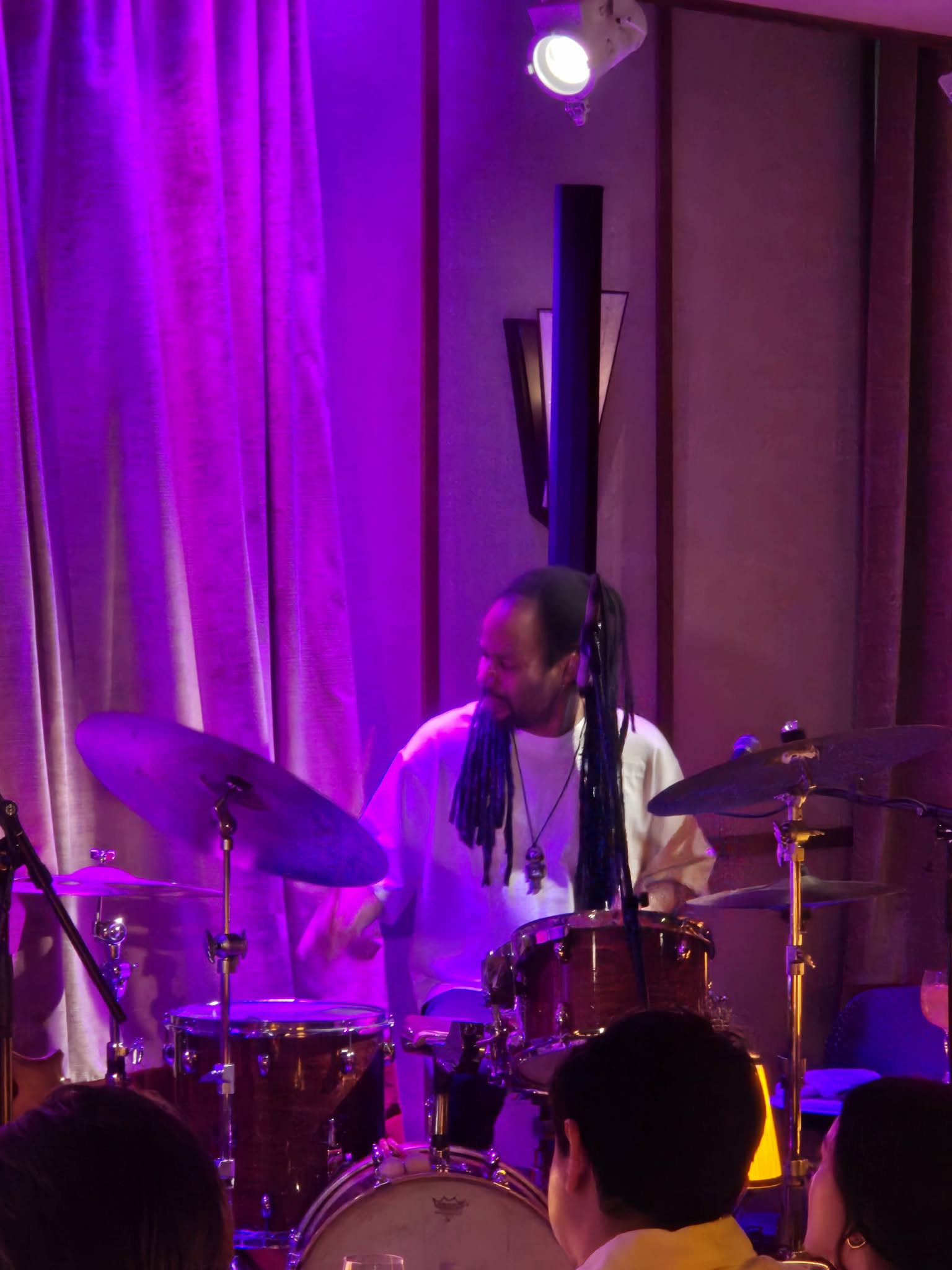
During the three evenings of The Latin Jazz Nights by Carlos Sarduy, Frank Durand appeared onstage alongside Carlos Sarduy Dimet, Cecilia Krull, Marco Poingt, Dany Noel and Reinier Elizarde “El Negrón”. It was a line-up in which every musician had a strong identity, and in which the rhythm had to remain solid enough to sustain the ensemble while being flexible enough to allow for improvisation.
Frank does not treat the drums as an instrument that must constantly prove its existence.
He does not try to fill every empty space, and he does not confuse energy with volume. At times, his presence is expressed through intensity and complexity. At others, it comes through a brief intervention, a shift in accent or a pause that changes the meaning of an entire musical phrase.
This is one of the defining qualities of a great jazz drummer: not merely keeping time, but transforming it.
An audience will often follow the melody, the voice or the solo instrument. Behind them, however, lies a rhythmic architecture upon which everyone’s freedom depends. A drummer must know where every musician is, anticipate changes and decide, sometimes in a fraction of a second, whether to support, challenge or withdraw.
Frank Durand does all this without creating the impression of calculation.
There is precision in his music, but no rigidity. There is strength, but no aggression. There is the rhythmic memory of Cuba, but it does not appear as a folkloric marker applied to jazz. It is organically integrated into the way he phrases and builds tension.
In his playing, polyrhythm is neither ornament nor a demonstration of virtuosity.
It is language.
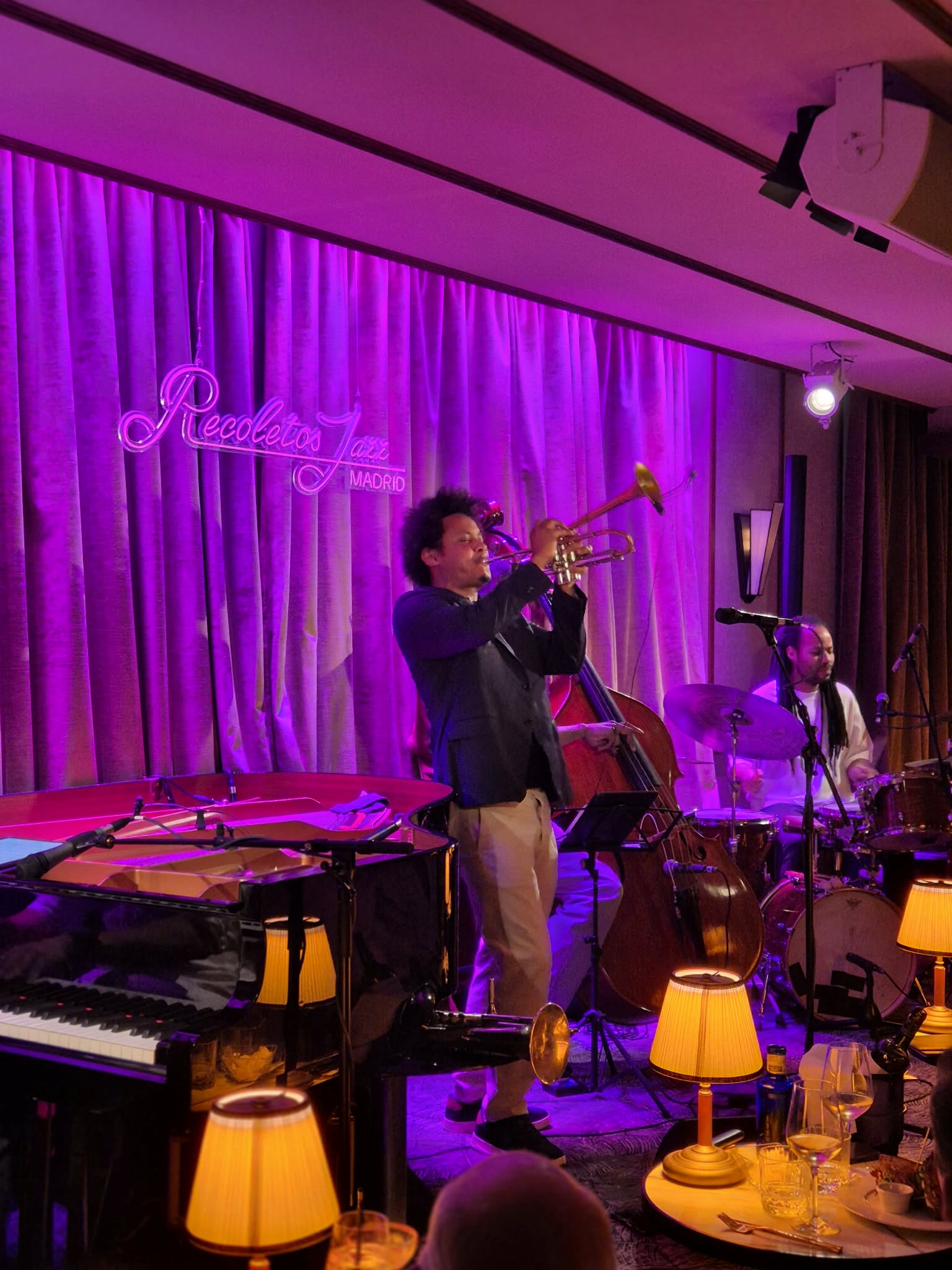
During the evenings at Recoletos Jazz, this quality became especially evident in his dialogue with Carlos Sarduy. Carlos’s trumpet can quickly alter the direction of a piece: it can heighten the intensity, fragment the theme, open an unexpected space or drive the ensemble towards an almost incandescent energy.
Frank does not simply react to these changes.
He carries them forward.
There is a musical understanding between the two of them, built not only on shared experience but also on trust. Carlos can take risks because he knows the rhythm will not collapse. Frank can shift the centre of the piece because he knows the trumpet will understand the invitation.
In a good concert, relationships like these do not need to be explained.
They can be heard.
For me, it was interesting to see him again in this context after our meeting in Barcelona. At first glance, the discreet man away from the stage and the highly energetic drummer might have seemed like two different personalities. In reality, they came from the same source.
Frank does not build his presence by dominating others.
As a person, he gives a conversation time and space. As a musician, he gives the ensemble exactly the same thing. He supports the others without becoming invisible and asserts himself without diminishing the freedom of his fellow performers.
This combination is difficult to achieve. In art, generosity can become excessive modesty, while authority can easily turn into ego. Frank remains between these extremes. He knows his own worth, but does not feel the need to announce it before he begins to play.
Friendship can alter the way we look at an artist. Sometimes, it prevents us from maintaining the distance required for a clear-eyed portrait. At other times, it gives us access to a dimension that the stage alone cannot reveal.
In Frank Durand’s case, personal closeness helped me understand the musician more fully.
Away from the stage, I saw a man who does not rush a conversation, who does not occupy space unnecessarily and who seems to understand that genuine relationships are not built from spectacular declarations. In Madrid, I recognised those same qualities in the way he shaped his musical interventions.
Not every great moment in a drummer’s performance is a solo.
Sometimes, a drummer’s value lies in what he makes possible for others: a trumpet phrase that can continue, a voice that finds its place, a piano that is free to take a risk or an ensemble that seems to breathe as a single organism.
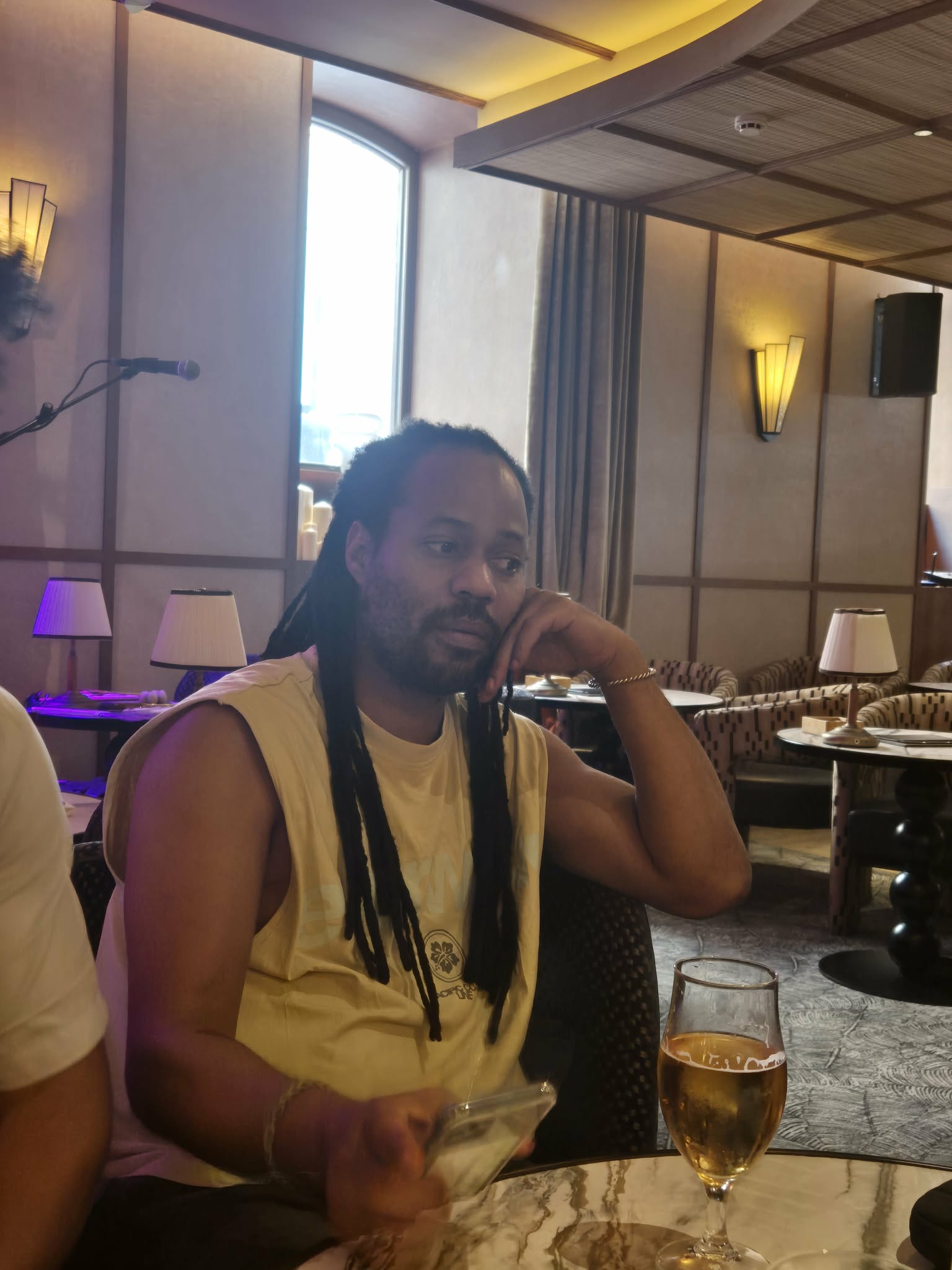
At Recoletos Jazz, Frank Durand was one of the essential presences throughout the three evenings, even when the audience’s attention was focused on another musician.
Perhaps this is his most profound form of authority.
I met him in Barcelona through a project that sought to connect jazz and theatre. I saw him again in Madrid, in a club where jazz preserves its intimacy and freedom. Between the two cities, a friendship took shape—one that I cannot reduce to an inaugural moment or a memorable phrase.
One certainty remains: sometimes, the person beyond the stage does not explain the musician, but helps us listen to him more closely.
And in Frank Durand’s case, the rhythm begins long before his hands touch the drums.
Andrei Slăvuțeanu